Shotgun has become the default alignment for most NFL offenses, largely because it is built around the passing game. Under center and pistol formations, by contrast, are more often associated with traditional, run-oriented schemes. This raises a natural question: does the quarterback's alignment on a given play have any measurable relationship with how well the running game performs?
Using play-by-play rushing data from the 2023–2025 NFL seasons, I compared rushing efficiency across the three alignments — shotgun, under center, and pistol — using both EPA (expected points added) and yards gained as outcome measures.
The setup
Every rushing play in the dataset was grouped by the quarterback's alignment at the snap. For each group, the distributions of EPA and yards gained were examined, and the differences between groups were tested for statistical significance using a Kruskal-Wallis test, followed by pairwise Mann-Whitney U tests with a Bonferroni correction applied across the three comparisons.
The sample sizes are heavily skewed toward shotgun, which reflects how the league is built today:
- Shotgun: 49,584 plays
- Under center: 8,863 plays
- Pistol: 1,505 plays
Shotgun outnumbers the other two alignments combined by roughly a five-to-one margin. As a result, the shotgun estimate is extremely precise, while the pistol estimate carries proportionally more uncertainty.
Rush EPA is lower out of shotgun
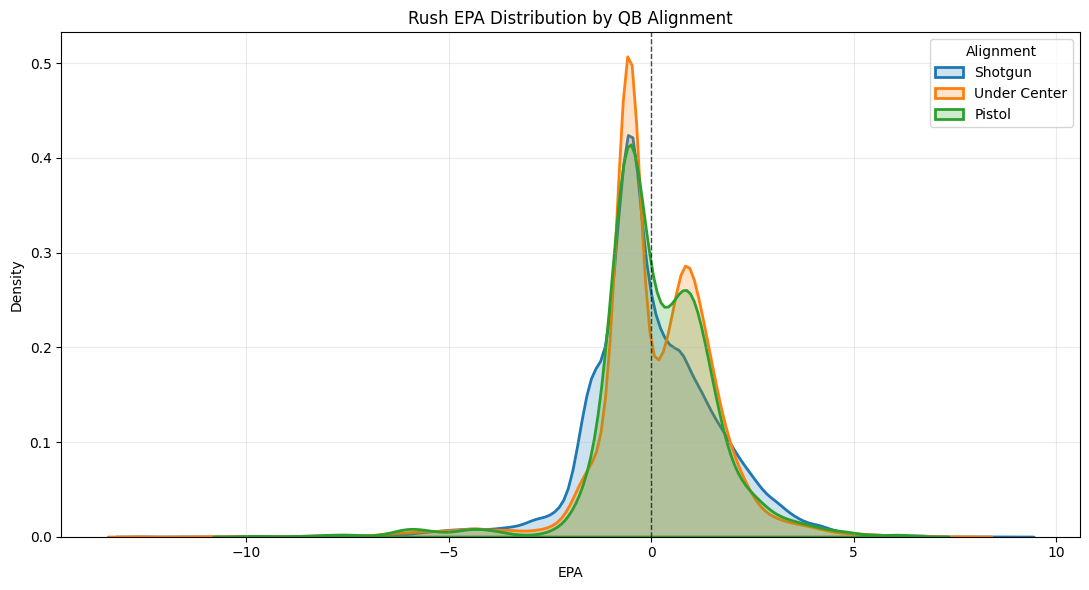
The EPA distributions point to a fairly clear pattern. Under center and pistol rushing plays sit almost on top of one another, both centered slightly above zero, while the shotgun distribution is shifted noticeably to the left.
- Shotgun: mean EPA = -0.015, median = -0.237
- Under center: mean EPA = 0.105, median = -0.065
- Pistol: mean EPA = 0.109, median = -0.067
The overall Kruskal-Wallis test confirms that the three alignments are not interchangeable (H = 144.41, p = 4.4e-32). The pairwise comparisons clarify where that difference comes from:
- Shotgun vs. under center: p = 1.7e-28 — highly significant
- Shotgun vs. pistol: p = 7.1e-07 — highly significant
- Under center vs. pistol: p = 1.0 — not significant
The pattern is consistent: shotgun rushing underperforms both other alignments by a comparable margin, while under center and pistol are statistically indistinguishable from one another. The positive-EPA rate reinforces this. Only 43.5% of shotgun runs generate positive EPA, compared to 48.9% under center and 48.5% out of pistol.
Yards gained follows the same pattern
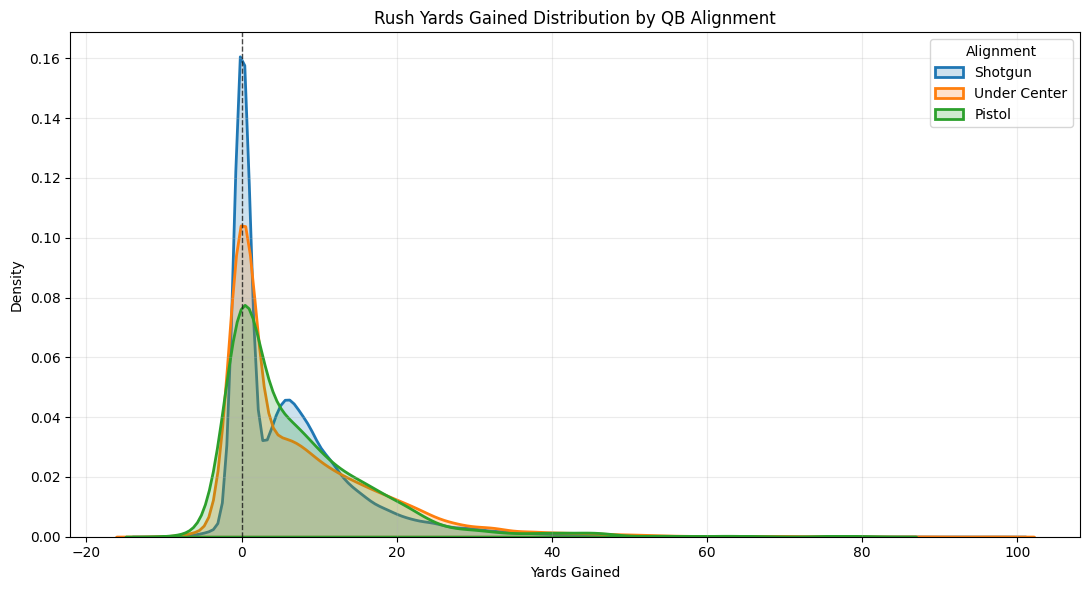
Raw yardage shows the same relationship as EPA, which serves as a useful cross-check. It suggests the effect is not simply an artifact of how EPA weighs down-and-distance situations.
- Shotgun: mean = 6.361 yards, median = 4.0
- Under center: mean = 7.503 yards, median = 3.0
- Pistol: mean = 7.210 yards, median = 4.0
The Kruskal-Wallis test is again significant (H = 37.63, p = 6.7e-09), and the pairwise breakdown closely mirrors the EPA results:
- Shotgun vs. under center: p = 6.8e-08 — significant
- Shotgun vs. pistol: p = 0.011 — significant
- Under center vs. pistol: p = 1.0 — not significant
Positive-yardage rates follow the same ordering: 57.0% for shotgun, 57.7% for under center, and 60.5% for pistol.
Interpreting the gap
Some caution is warranted in interpreting these results. The finding is consistent and statistically robust across two independent outcome measures, which provides a meaningfully stronger basis than a single test would offer on its own. That said, this remains observational, play-level data. It does not control for down and distance, defensive personnel, or box counts, all of which are correlated with why a team chooses shotgun in the first place. Shotgun is used disproportionately on passing downs and in other clear passing situations, where defenses tend to play lighter boxes but remain alert to a potential draw or zone-read look. It is also used more frequently in two-minute and hurry-up situations, where establishing the run is not the priority. A meaningful share of the shotgun rushing gap is therefore likely explained by play-calling context rather than by the alignment itself being mechanically worse for run blocking.
What the data does support is more specific: across three full seasons, rushing plays out of shotgun have produced measurably worse outcomes, by both EPA and yards, than rushing plays out of under center or pistol, while under center and pistol perform equivalently to one another on both measures. That is a narrower and more defensible claim than "shotgun hurts the run game," and it is the one the numbers actually support.
Takeaways
- Shotgun rushing underperforms under center and pistol rushing on both EPA and yards gained, with the gap reaching statistical significance in both cases.
- Under center and pistol are statistically indistinguishable from each other on every measure tested, with no evidence that pistol behaves as a "compromise" between the other two alignments.
- The result replicates across two independent outcome metrics, which strengthens confidence that this reflects a genuine pattern in the data rather than a quirk of a single measure.
- Causation remains an open question. Shotgun rushing likely occurs within a different distribution of game situations than under-center or pistol rushing, and this analysis does not isolate alignment from those confounding factors.